Tổ nghề và danh nho nước việt- Văn Miếu 2026 ← Back to the portfolio
- In →
- Installation
- Photo
Từ Dự án “Chuyện Đình trong Phố” tới “Tổ nghề và danh Nho nước Việt”
Lịch sử Thăng Long – Kẻ Chợ gắn liền với sự chuyển dịch sang sản xuất tiểu thủ công nghiệp và thương mại đô thị. Từ thời Lê sơ – Mạc đến thời Lê Trung Hưng, thợ thủ công tinh hoa từ khắp các làng nghề Bắc Bộ di cư về đây lập nghiệp, tạo nên cấu trúc tên gọi phố “Hàng…”. Dù ở phố, cư dân vẫn giữ tín ngưỡng thành hoàng, xây dựng những ngôi đình trong phố để thờ vọng Tổ nghề. Di sản quý giá này chính là khu phố cổ Hà Nội ngày nay. Trải qua đô thị hóa, phần lớn trong số hơn 60 ngôi đình đã bị biến đổi công năng. Nhờ nỗ lực trùng tu của thành phố, nhiều đình thờ tổ nghề nổi tiếng (Nam Hương, Hà Vĩ, Kim Ngân, Tú Thị…) đã được phục hồi, đóng vai trò là không gian gắn kết cộng đồng.
Trước bối cảnh nhiều phường nghề xưa dần mai một, dự án “Chuyện Đình trong Phố” đã ra đời nhằm đánh thức niềm tự hào truyền thống, biến hệ thống đình tổ nghề thành không gian sáng tạo nghệ thuật. Đến nay, hơn 10 ngôi đình đã hồi sinh rõ nét qua các triển lãm gắn liền với lịch sử nơi chốn. Tiếp nối dòng chảy đó, tại Lễ hội Thiết kế sáng tạo Hà Nội 2026, dự án sẽ đồng loạt mở cửa tại 12 ngôi đình trong phố cổ. Bên cạnh các điểm đến quen phục, lễ hội ra mắt các không gian đối thoại mới tại đình Cổ Vũ, Xuân Phiến Thị, Hành Tích, Hoa Lộc Thị… giúp công chúng nhận diện sâu sắc mạch ngầm di sản.
Hướng tới kỷ niệm 950 năm thành lập Quốc Tử Giám (1076–2026), Trung tâm Hoạt động Văn hóa Khoa học Văn Miếu – Quốc Tử Giám tổ chức khai mạc triển lãm “Tổ nghề và danh Nho nước Việt”. Sự kiện không chỉ mở màn cho Lễ hội Thiết kế sáng tạo 2026 mà còn tiếp nối hành trình đánh thức ký ức đô thị từ dự án “Chuyện Đình trong Phố”. Trong lịch sử giáo dục Việt Nam, nhiều nhà khoa bảng được ghi danh trên bia Tiến sĩ tại Văn Miếu còn có đóng góp thiết thực trong việc truyền bá tri thức, phát triển kỹ nghệ và được nhân dân tôn vinh làm tổ nghề. Triển lãm lần này giới thiệu về 8 vị Tiến sĩ và nhà Nho Đặng Huy Trứ với nghề nhiếp ảnh, tạo nên sợi dây liên kết đặc biệt giữa đạo học và đời sống dân sinh:
Nghề In mộc bản (TS. Lương Như Hộc): Giới thiệu tranh khắc của nghệ nhân Nguyễn Công Đạt, Nguyễn Công Tráng và tác phẩm khắc gỗ từ Thanh Uy Gallery cùng các họa sĩ.
Nghề Dệt chiếu (TS. Phạm Đôn Lễ): Không gian sắp đặt của họa sĩ Vũ Xuân Đông kết hợp cùng nghệ nhân làng chiếu Nga Sơn.
Nghề Sơn ta (TS. Trần Lư): Kỹ thuật sơn ta thếp vàng từ họa sĩ Nguyễn Tuấn Cường, An Nguyễn và nhóm sơn mài HD.
Nghề Ép dầu (TS. Nguyễn Quang Tán): Tác phẩm điêu khắc của Thái Nhật Minh và đèn hình chim của Đinh Văn Trọng.
Nghề Dệt lượt (TS. Phùng Khắc Khoan): Thực hành dệt của nghệ nhân La Khê kết hợp thiết kế áo dài của sinh viên thiết kế VNU-SIS.
Nghề Thêu (TS. Lê Công Hành): Tác phẩm của Phạm Ngọc Trâm kết hợp tranh lụa đương đại và kỹ thuật thêu vá của Đoàn Văn Tới.
Nghề Thuộc da (TS. Nguyễn Thời Trung): Giới thiệu bởi nghệ nhân Cao Quynh và nhà nghiên cứu Phạm Long.
Nghề Dát thiếc (TS. Nguyễn Chính): Các tác phẩm tranh lụa, điêu khắc, thiết kế của Yến Năng, Đỗ Hiệp, Ngô Nhật Thanh và Nam Chi.
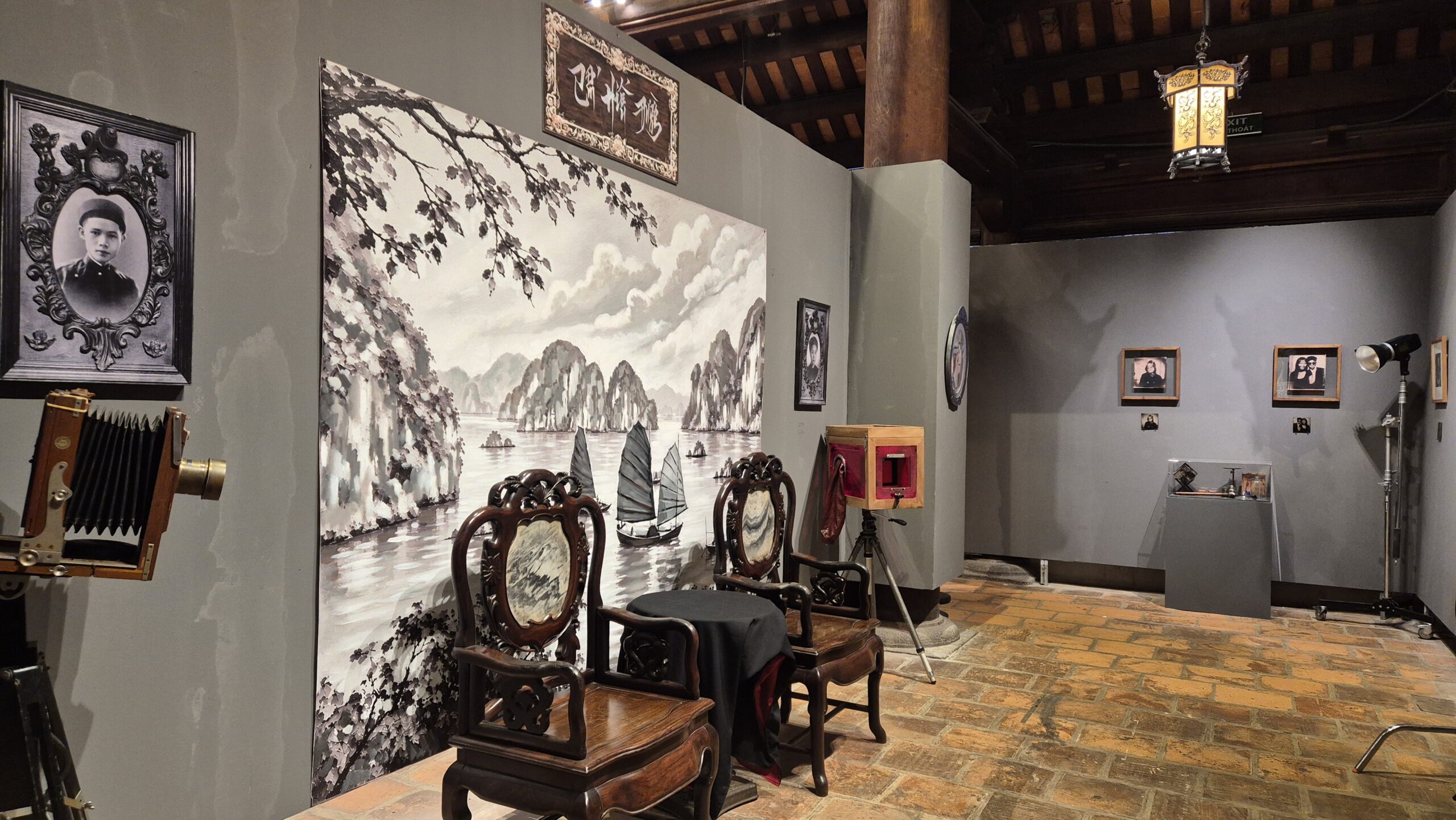
Nghề Nhiếp ảnh (nhà Nho Đặng Huy Trứ): Kết nối lịch sử với thực hành hình ảnh đương đại qua tác phẩm của Nguyễn Thế Sơn, Phạm Duy và sinh viên nhiếp ảnh VNU-SIS.
Đặc biệt, hệ thống bia khắc mica do họa sĩ Trần Hậu Yên Thế thực hiện đã tạo nên gạch nối sáng tạo giữa hình tượng bia đá truyền thống với ngôn ngữ thị giác hiện đại. Triển lãm được thiết kế như cuộc đối thoại sống động giữa tư liệu lịch sử, các sản phẩm thủ công và nghệ thuật đương đại (mộc bản, sơn mài, tranh thêu, điêu khắc, sắp đặt…).
Triển lãm “Tổ nghề và danh Nho nước Việt” không chỉ tôn vinh truyền thống hiếu học, tinh thần trọng tri thức của dân tộc, mà còn định hình di sản như một nguồn tri thức sống, truyền cảm hứng mạnh mẽ cho cộng đồng và sự phát triển đô thị đương đại.
Giám tuyển Nguyễn Thế Sơn
From “Stories of Communal Houses in the Old Quarter” to “Craft Patron Saints and Eminent Confucian Scholars of Vietnam”
The history of Thăng Long – Kẻ Chợ is closely associated with the transition towards small-scale handicraft production and urban commerce. From the Early Lê and Mạc dynasties through the Revival Lê period, skilled master artisans from craft villages across the Northern Delta migrated to the capital to establish their livelihoods, giving rise to the distinctive street-naming convention of “Hàng…” (literally, “street of…”), which remains a defining feature of Hanoi’s Old Quarter today. Despite their urban setting, residents continued to uphold the worship of village tutelary deities and built communal houses (đình) within the streets to pay homage to the founding masters of their respective crafts. This precious heritage forms the historical foundation of what is now Hanoi’s Old Quarter. As the city underwent urbanisation, most of the more than 60 communal houses gradually lost their original functions or were repurposed. Thanks to the city’s restoration efforts, several renowned craft-founder temples, including Nam Hương, Hà Vĩ, Kim Ngân and Tú Thị, have been revitalised, once again serving as spaces that foster community bonds.
Against the backdrop of the gradual disappearance of traditional craft guild communities, the project “Stories of Communal Houses in the Old Quarter” was initiated to rekindle pride in traditional heritage and transform the network of craft-founder communal houses into spaces for artistic creativity. To date, more than ten communal houses have undergone remarkable revitalisation through exhibitions deeply rooted in the histories and identities of their respective locations. Continuing this journey, as part of the Hanoi Creative Design Festival 2026, the project will open its doors simultaneously at 12 communal houses throughout the Old Quarter. Alongside familiar destinations, the festival will introduce new spaces for dialogue at Cổ Vũ, Xuân Phiến Thị, Hành Tích and Hoa Lộc Thị communal houses, among others, inviting the public to gain a deeper understanding of the underlying currents of the city’s cultural heritage.
Marking the 950th anniversary of the establishment of the Imperial Academy (Quốc Tử Giám, 1076–2026), the Centre for Cultural and Scientific Activities at the Temple of Literature – Imperial Academy is organising the opening of the exhibition “Craft Patron Saints and Eminent Confucian Scholars of Vietnam.” The event not only inaugurates the Hanoi Creative Design Festival 2026 but also continues the journey of awakening urban memories initiated by the project “Stories of Communal Houses in the Old Quarter.”
Throughout the history of Vietnamese education, many distinguished scholars whose names are inscribed on the doctoral steles at the Temple of Literature also made practical contributions to the dissemination of knowledge and the development of traditional industries. For these contributions, they were honoured by the people as founding masters of various crafts. This exhibition introduces eight doctoral laureates and the Confucian scholar Đặng Huy Trứ, whose pioneering contribution was to the art of photography, establishing a distinctive connection between scholarly traditions and everyday social life.
The exhibition features nine thematic sections:
Woodblock Printing (Doctor Lương Như Hộc): Featuring prints and woodblock carvings by artisans Nguyễn Công Đạt and Nguyễn Công Tráng, alongside woodblock works from Thanh Uy Gallery and collaborating artists.
Mat Weaving (Doctor Phạm Đôn Lễ): An installation by artist Vũ Xuân Đông, created in collaboration with artisans from the traditional mat-weaving village of Nga Sơn.
Traditional Vietnamese Lacquer (Doctor Trần Lư): Exploring traditional lacquer techniques and gold-leaf gilding through works by artists Nguyễn Tuấn Cường, An Nguyễn and the HD Lacquer Group.
Oil Pressing (Doctor Nguyễn Quang Tán): Sculptural works by Thái Nhật Minh and bird-shaped lamps by Đinh Văn Trọng.
Silk Gauze Weaving (Doctor Phùng Khắc Khoan): Weaving demonstrations and practices by artisans from La Khê, combined with áo dài designs by fashion design students from VNU-SIS.
Embroidery (Doctor Lê Công Hành): Works by Phạm Ngọc Trâm, presented alongside contemporary silk paintings and traditional patchwork and embroidery techniques by Đoàn Văn Tới.
Leather Tanning (Doctor Nguyễn Thời Trung): Introduced through the contributions of artisan Cao Quynh and researcher Phạm Long.
Tin Foil Gilding (Doctor Nguyễn Chính): Silk paintings, sculptures and design works by Yến Năng, Đỗ Hiệp, Ngô Nhật Thanh and Nam Chi.
Photography (Confucian Scholar Đặng Huy Trứ): Connecting historical perspectives with contemporary image-making practices through works by Nguyễn Thế Sơn, Phạm Duy and photography students from VNU-SIS.
Of particular note is the series of acrylic steles created by artist Trần Hậu Yên Thế, which establishes a creative bridge between the traditional imagery of stone doctoral steles and the visual language of modernity. The exhibition is conceived as a dynamic dialogue between historical documents, traditional handicrafts and contemporary art practices, encompassing woodblock printing, lacquer art, embroidered paintings, sculpture, installation and other forms of artistic expression.
The exhibition “Craft Patron Saints and Eminent Confucian Scholars of Vietnam” not only celebrates the nation’s longstanding tradition of learning and its profound respect for knowledge, but also redefines heritage as a living source of knowledge — one that continues to inspire communities and contribute meaningfully to contemporary urban development.
Curator Nguyễn Thế Sơn
Related Projects
-
 view project
WINK HANOI-2027
-
 view project
Lễ hội thiết kế sáng tạo Hà Nội 2026
-
 view project
The 7th Guangxi Public Art Season -2026
-
 view project
Vinh qui bái tổ- Quốc Tử Giám trong nghệ thuật-2026
-
 view project
120 năm ĐHQG -2026
-
 view project
Cảm thức Đông Dương- Indochina Sense- 2024
-
 view project
Hồn nhiên như cô tiên- 22 Hàng Buồm-2022
-
 view project
Sợi kết nối – VCCA- 2022
-
 view project
Tuần lễ khơi nguồn sáng tạo Hà nội-2021
-
 view project
Ký ức 22 Hàng Buồm- 2021
-
 view project
Ký ức những con đường – Đà lạt 2021
-
 view project
Eco Sus- ICISE Qui nhơn – 2021
-
 view project
Nước mặn làng sông- ICISE quy nhơn- 2021
-
 view project
Gió đầu mùa- sentia 2021
-
 view project
“ỐNG thở” – VUUV – 2020
-
 view project
“Carriers” Project at Academy Minerva – The Neitherlands 2019
-
 view project
Tranh tối tranh sáng- Agohub 2019
-
 view project
Hành trình lịch sử- Hầm nhà Quốc hội – 2018
-
 view project
“Những người chở” at phùng hưng street- 2018
-
 view project
…carrying the carriers… – Into thin air- Manzi 2016
-
 view project
16 coffee tables installation exhibition – Artvietnam Gallery 2016
-
 view project
8m2- Photo-installation exhibition at Goethe Institut 2015
-
 view project
story of 16 coffee tables- mien meo mieng- umea 2015
-
 view project
“Dự cảm Sông” in “River Scape in Flux” Exhibition – 2012
-
 view project
How to return “Honda” to Japan? – Làm cách nào để trả “Honda” về nước Nhật? – 2012
-
 view project
Mountain links with moutain, river links with river – Núi liền núi, sông liền sông – 2012
-
 view project
Detail of Nha Mat Pho
-
 view project
Nhà mặt phố (Relievo – phù điêu) 2012
-
 view project
Nặng bồng nhẹ tếch (HUẾ 2010)
-
 view project
Nước xa lửa gần – 2007
-
 view project
High above -Trên cao – 2007
-
 view project
Headwash – Gội đầu – 2005
-
 view project
Within the room – Phía trong bức tường – 2005
-
 view project
Tree & life – 2005
-
 view project
Story of water – Câu chuyện của nước -2004
-
 view project
Dấu chân thế kỷ- Vân Nam 2026
-
 view project
Trầm tích của ánh sáng – 2026
-
 view project
Moskva – Hà Nội – Những khung cảnh lạc quan-2026
-
 view project
Những ngã rẽ – Crossroads – 2025
-
 view project
Hoài niệm về những thành phố- 2025
-
 view project
WINK HAI PHONG-2025
-
 view project
WINK CAN THO- 2024
-
 view project
WINK TUY HÒA – 2024
-
 view project
Dòng chảy kết nối- Connection flow – VNU-SIS 2023
-
 view project
Dalat ART Street Biennale- Đà Lạt 2023
-
 view project
Mười năm phơi sáng- ArtVietnam Gallery 2023
-
 view project
Xưa và nay, đổi thay đường phố Hà Nội- Manzi 2023
-
 view project
Hanoi Photo Biennale 2023- 22 Hang Buom
-
 view project
Wink Đà nẵng Riverside-2023
-
 view project
Wink Đà nẵng Centre- 2022
-
 view project
Bandung photography triennale -Indonesia -2022
-
 view project
X.E.M 10- Negative Plus – Đà Lạt 2021
-
 view project
Mây bay về núi- Đà Lạt 2021
-
 view project
Wink Saigon – 75 Nguyen Binh Khiem – HCMC 2020
-
 view project
“Đi về phía Đông”-Mơ về phong cảnh- Apricot Hotel 2020
-
 view project
Bandong photo showcase- Indonesia 2020
-
 view project
Collective City – Seoul Biennale 2019
-
 view project
Journey to the windmill land- Groningen 2019
-
 view project
Triển lãm “Núi liền núi, sông liền sông” – Hongkong 2019
-
 view project
Mountain Connecting Mountain, River Connecting River- lumenvisum Hong Kong 2019
-
 view project
Exhibition Journey to the Seven-Hill Land- agohub 2019
-
 view project
Hành trình tới xứ sở bảy ngọn đồi- Agohub 2019
-
 view project
Đình Bảng- Hầm nhà quốc hội – 2018
-
 view project
Hà Nội – Huế – Sài gòn – Hầm nhà quốc hội – 2018
-
 view project
triển lãm tranh lụa và điêu khắc nhỏ – VCCA – 2018
-
 view project
midway studio- worcester – 2018
-
 view project
Nhẹ tựa lông hồng (Light as Pink Feather)- Worcester Museum 2018
-
 view project
ART on the Street – Boston – 2018
-
 view project
worcester museum art open studio – 2018
-
 view project
“Máy nước thời gian” at Phung Hung street- 2018
-
 view project
“City and Memory” at AGOhub Art space-2018
-
 view project
“Colour of the sound” in K-art Gallery- Seoul 2017
-
 view project
Vietnam Eyes: blood, sweat and tears-Saatchi 2017
-
 view project
Lost in the city’s jungle-Work room four 2017
-
 view project
“Thay hình đổi mặt” exhibition at l’espace -2016
-
 view project
Dự án “Thay hình đổi mặt” – 2016
-
 view project
Đi về phía Đông-Go to the East – VNUFA 2015
-
 view project
Ha noi- A living museum-Hanoi Old Quarter Cultural Exchange Center 2015
-
 view project
8m2 in processing – VNUFA 2014
-
 view project
“8m2” project at “Journey to a Green Vietnam” Exhibition
-
 view project
Reality chimerical photography exhibition in Paris-2014
-
 view project
Vietnam now exhibition in Amsterdam-2014
-
 view project
Lost and Found Ha noi: The openning of Book launch and Exibition
-
 view project
VINATREE photo-installation in I-CAMP project at Muong studio, Hoa Binh
-
 view project
Nha mat pho-night series at ASEAN-Korea Contemporary Art Exhibition, Seoul
-
 view project
Open studio at 502 studio
-
 view project
Từ Phố Phái đến Nhà Mặt Phố-Exhibition at Eight Gallery
-
 view project
Nha Tay transforms Exhibition at manzi Art Space,Hanoi-2013
-
 view project
Dự án “Nhà Tây biến hình”- 2013
-
 view project
“I am looking for the communal house” Photo Installation at VNUFA
-
 view project
Dự án “Tôi đi tìm ngôi nhà chung”
-
 view project
Nắng Sài gòn series exhibition at Viet Art Center
-
 view project
“River scape in Flux” Exhibition in Metropolitan of Art Museum,Manila
-
 view project
Nhà Mặt Phố at Cactus Gallery-2012
-
 view project
Nha mat pho Sai gon in detail
-
 view project
Nhà mặt phố – Sài gòn 2012
-
 view project
“The road home is far away” at Chula 2012
-
 view project
“VIETNAM NOW” Exhibition at Exchange Square, Hong Kong – 2012
-
 view project
“Nhà mặt phố” in “The Start of a Long Journey” Excellent Graduation Works Exhibition at CAFA ART MUSEUM – 2012
-
 view project
Dự án “Nhà Mặt Phố”
-
 view project
Houses facing the street (night series)
-
 view project
Houses facing the street (day series)
-
 view project
Four seasons suite – Tổ khúc bốn mùa – 2011
-
 view project
The road home is far away – Đường về còn xa lắm – 2011
-
 view project
Beijing go ahead – Bắc Kinh thẳng tiến – 2011
-
 view project
Premonition – Dự cảm – 2010
-
 view project
Rong – Tan chảy – 2009
-
 view project
The group – Nhóm – 2008
-
 view project
Oasis of silence – Ốc đảo tĩnh lặng – 2008
-
 view project
Vinatree – Cây Việt Nam – 2007
-
 view project
Leaf’s shadow – Bóng lá – 2005